About 4:00 Friday afternoon I received a SMS from cingular on my cell welcoming me as a Cingular customer. I didn't think much of it at the time, but discovered by 5:00 that my phone had ceased to work. Ironically, I discovered if first when I went to check my email, and it couldn't connect. I then tried to call my cell phone, when I got a "beep beep beep" -- secret code for "your phone isn't answering anymore".
Later, I tried to make a phone call on the phone, and got the "Welcome Cingular Customer" greeting. I was asked if I wanted to activated service -- Well, yes, I would like my phone to work ;-)
After giving them my last 4 digits of my social security number, I then got the following spiel. This is a paraphrase, I am sure that I may missed specific wording, but it's close enough:
"Welcome Cingular Customer! Understand that by agreeing to the terms of the following contract, that you will be liable for all charges. Any trial services may incur additional charges after the first month of free service. This contract will be for a 2 year period of time. Press 1 to agree to the terms of this contract, press * to hear this again."
Beyond the obvious question, whether this is actually an enforceable contract (by pressing one key on my cell phone, I am signing a contract worth a minimum of $1200, , there is a secondary issue. Whoever thought of this was an evil genius. There is no secondary option, which would be "decline" -- at least none is presented to the user. Of course, I just hung up. But I wonder if someone could be felt to compelled to press "1", because "there was no other choice". I have to believe that this was designed on purpose.
This is another example of how computer/human interactions can be shaped by playing off of the user's expectations. Up until this last menu, I was always given a secondary option -- press the number 2 to exit. But here, at the point where I am presented with the contract agreement, that option is taken away, implying that there is no other option.
I have been thinking about this a lot. I certainly don't want to paint Cingular as a evil entity -- in fact, I have been up to now quite happy with my service. However, I am reminded of examples of this very same phenomena in educational environments, where the plot is shaped in a way that on purpose, or even worse, by accident, the narrative is broken. The irony remains that in many of these cases, it is simply brushed off as a "programming mistake" or "oversight", but the very process by which the narrative is delivered can shape how the user interacts with it -- okay not so profound, but when we think of things like LMS systems, web publication systems, presentation software, things where in the interest of simplicity options are limited, unintended consquences may be the result. And it may be that we will not see this ourselves, immersed in the center of these software systems.
--hal
p.s. yes, I got my phone working again. A helpful fellow at a Cingular store set me straight. The irony is that it is because I am getting a Blackberry for testing, in addition to my existing phone, and wanted it added to my service. The University won't pay for service on cell phones, so I am paying for it out of my pocket. Another example of the ongoing cost of education ;-)
Sunday, January 29, 2006


Thursday, January 26, 2006
Notes from a Meeting
Just what do I write on my P900 while in a meeting on our organization?
------------start here-----------
think outside (what box?)
renew our commitment to our students
embrace our entrepreneur side by allowing funding and resource commitments for staff faculty student startups (google model)
mobile ls a key piece, not necessarily laptops or 802.11
do not be afrald to take risks -- you are either living or dying
the future is small
small services
small devices
little things can have big impact but only if everyone can play
user centric may be at odds with how we do business now (example: allowing students a richer set of network based services including the opportunity to develop their own applications and content)
most use of technology in teaching is focused on scaling not on improving learning. Be skeptical of "business models" when talking about education. Education doesn't scale.
converge video services (on demand, streaming and archive) follow self publishing model with minimal hierarchy and multiple channels of output (tv rss web mobile)
web conferencing should be a commodity service open to everyone
leverage our physical space and radically rethink based on what our students need not on what scales (rows of neat computers sit empty while students spread out their stuff) explore a design studio model (sort of like flyspace but different)
------------start here-----------
think outside (what box?)
renew our commitment to our students
embrace our entrepreneur side by allowing funding and resource commitments for staff faculty student startups (google model)
mobile ls a key piece, not necessarily laptops or 802.11
do not be afrald to take risks -- you are either living or dying
the future is small
small services
small devices
little things can have big impact but only if everyone can play
user centric may be at odds with how we do business now (example: allowing students a richer set of network based services including the opportunity to develop their own applications and content)
most use of technology in teaching is focused on scaling not on improving learning. Be skeptical of "business models" when talking about education. Education doesn't scale.
converge video services (on demand, streaming and archive) follow self publishing model with minimal hierarchy and multiple channels of output (tv rss web mobile)
web conferencing should be a commodity service open to everyone
leverage our physical space and radically rethink based on what our students need not on what scales (rows of neat computers sit empty while students spread out their stuff) explore a design studio model (sort of like flyspace but different)
Wednesday, January 25, 2006
Deleting TV
Unwittingly I have been performing a survey on my friends and associates concerning Television. I was looking at my DirectTV bill, and realized that I am paying almost $50.00 a month for something that I watch perhaps 1 hour a day (and that is declining rapidly). On top of that, a lot of it is regular broadcast TV (with the exception of IFC, TCM and Adult Swim).
A fair number of the people that I know have either minimal cable (local channels) or just off the air (or not at all).Some have NetFlix, because they have kids.
Considering all the other options that I now have to consume my time, paying for access to broadcast TV is beginning to look more and more like an expense I can forgo.
Downloadable and on-demand content is accelerating. There is now a critical amount of it that is simply free. Expect to see more advertising supported commercially produced programming available online. Adult Swim offers their Friday night fix at the wee hours of the morning.
There is Google Video, there is iTunes Music/Video store, where you can download a free Monk episode. There is archive.org's moving pictures archive. I would love to teach a film course using just their content.
Really, it's a bit funny. About the time that cable is moving towards ala carte programming (which consumers have wanted for years), the busines is getting ready to take a big turn.
I am certainly not the trendsetter here. I think the thoughts I am having (why do I pay for TV, when most of it I don't want) is going through anyone's head that has a broadband connection. Certainly, the user experience will have to change as it transitions to the living room. I am not going to give up my remote just yet. MythTV has done a fair amount of integrating internet services into a television experience, but I am also betting that Apple has something up it's sleeve.
I think what we see as FrontRow right now is really just a test. Think what happens when FrontRow meets the iTunes store.
--hal
A fair number of the people that I know have either minimal cable (local channels) or just off the air (or not at all).Some have NetFlix, because they have kids.
Considering all the other options that I now have to consume my time, paying for access to broadcast TV is beginning to look more and more like an expense I can forgo.
Downloadable and on-demand content is accelerating. There is now a critical amount of it that is simply free. Expect to see more advertising supported commercially produced programming available online. Adult Swim offers their Friday night fix at the wee hours of the morning.
There is Google Video, there is iTunes Music/Video store, where you can download a free Monk episode. There is archive.org's moving pictures archive. I would love to teach a film course using just their content.
Really, it's a bit funny. About the time that cable is moving towards ala carte programming (which consumers have wanted for years), the busines is getting ready to take a big turn.
I am certainly not the trendsetter here. I think the thoughts I am having (why do I pay for TV, when most of it I don't want) is going through anyone's head that has a broadband connection. Certainly, the user experience will have to change as it transitions to the living room. I am not going to give up my remote just yet. MythTV has done a fair amount of integrating internet services into a television experience, but I am also betting that Apple has something up it's sleeve.
I think what we see as FrontRow right now is really just a test. Think what happens when FrontRow meets the iTunes store.
--hal
Monday, January 16, 2006
Blackberry and LMS
It has been a month ago that I wrote about Blackberry. Since then, another of NTP's patents has been rejected. While this is good news for Blackberry users, I don't think it really solves Blackberry's biggest problem, which is innovating itself out of it's proprietary environment. Java support is good, a better web browser will help, but I can't help but feel that it will always lag behind.
I have been thinking recently about Learning Management Systems. I certainly have quite mixed feelings about them. To be completely up front, my experience with LMS's is restricted to our campus's WebCT system, where I have used it as a student, peripherally supported it with questions using digital media with it, and 3 days worth of training on using it as an instructor.
It appears to me that an LMS is best suited for highly structured curriculum, which would be of more use in a k-12 environment. There is so much emphasis on consistency (Industrial Revolution thinking again) in the learning environment that an LMS is a compelling solution.
The closed nature of an LMS is attractive, as a way to lock down content to only those authorized to see it. However, this also bothers me, particularly when considering it's use in higher education.
I attended a presentation a while back, where one of the presenters was using a LMS system for course content. They had asserted that their content was open for anyone to use, but of course, it is not. It appeared that the faculty member did not themselves understand that their content was now restricted, unable to be viewed by a casual observer -- at least until this presentation, where another faculty member pointed this out to them.
So, what future with Universities follow? Will it be the path of the Blackberry, a proprietary one that offers great integration, at the price of flexibility? Or will it be an open one, based on an academic tradition of open exchange of knowledge combined with credit and respect, where we have to compete in the marketplace of ideas?
--hal
I have been thinking recently about Learning Management Systems. I certainly have quite mixed feelings about them. To be completely up front, my experience with LMS's is restricted to our campus's WebCT system, where I have used it as a student, peripherally supported it with questions using digital media with it, and 3 days worth of training on using it as an instructor.
It appears to me that an LMS is best suited for highly structured curriculum, which would be of more use in a k-12 environment. There is so much emphasis on consistency (Industrial Revolution thinking again) in the learning environment that an LMS is a compelling solution.
The closed nature of an LMS is attractive, as a way to lock down content to only those authorized to see it. However, this also bothers me, particularly when considering it's use in higher education.
I attended a presentation a while back, where one of the presenters was using a LMS system for course content. They had asserted that their content was open for anyone to use, but of course, it is not. It appeared that the faculty member did not themselves understand that their content was now restricted, unable to be viewed by a casual observer -- at least until this presentation, where another faculty member pointed this out to them.
So, what future with Universities follow? Will it be the path of the Blackberry, a proprietary one that offers great integration, at the price of flexibility? Or will it be an open one, based on an academic tradition of open exchange of knowledge combined with credit and respect, where we have to compete in the marketplace of ideas?
--hal
Wednesday, January 11, 2006
Games as Activism
What follows is a from a blog I frequent -- "We Make Money not Art" -- it deals with activism, art, free speech. The following thread is quite interesting. It was started by a discussion of an academic conference on Gaming, but It further illustrates that gaming has morphed into a legitimate narrative form, much like what happened to film in the early part of the 20th century. I think in the light of the recent article on why British kids can't read, we have to think about not just the excesses of the application of technology to teaching, but what literacy really means.
Sample paragraph:
The main public for these games is neither teenagers nor kids, but adults. Moreover, the rules of these games are not the ones you would encounter in a commercial games: the aim is not to attract as many game addicts during as much time as possible; to captivate with an aesthetics as realist as possible or with the most original design; to attain as much identification to the hero as possible; to be the most competitive on the market; to satisfy the ego of the teenager that still lurks in each of us by killing what moves on the screen... the aim is not to win. The aim is to subvert and parody preconceived ethics and aesthetics; to generate reflection.
Start here:
And then here:
And then, finally, here:
--hal
Sample paragraph:
The main public for these games is neither teenagers nor kids, but adults. Moreover, the rules of these games are not the ones you would encounter in a commercial games: the aim is not to attract as many game addicts during as much time as possible; to captivate with an aesthetics as realist as possible or with the most original design; to attain as much identification to the hero as possible; to be the most competitive on the market; to satisfy the ego of the teenager that still lurks in each of us by killing what moves on the screen... the aim is not to win. The aim is to subvert and parody preconceived ethics and aesthetics; to generate reflection.
Start here:
And then here:
And then, finally, here:
--hal
Friday, December 16, 2005
BlackBuried
It may seem from my title that I am going to write about Blackberry's recent successes and setbacks reaching a resolution to the patent saga. Likely something will eventually be worked out, because it is both company's best interest to do so, so ignore the dire warnings that service may be stopped, etc.
However, this is an opportunity to think about how services and devices are tied to one another, and what the ramifications are of that.
Push email is Blackberry's killer app, and their devices mirror that functionality with the great thumb board, and an experience that makes reading and sending email a transparent experience.
The way that Blackberry does this is with their intermediate server technology, which talks between an email server and the device. Blackberry's initial technology for transporting data was using pager technology, and this infrastructure design betrays it's past. Now, it's moderately more sophisticated, but just moderately.
This is Blackberry's problem. They are a device manufacturer, they are a service provider, they are a software developer. They have a devoted following.
However, cell phones are getting smarter. The Treo is a decent replacement, and soon there will be devices that even more closely mirror the device functionality of the Blackberry, but do not need the Blackberry data service, since they will have sophisticated enough email clients, and fast enough data connections, where push email may be as quaint an idea as the pager itself.
The message here is only peripherally about Blackberry. It is really about the validity of open standards combined with services and devices. It becomes a marketplace of ideas, where people are able to choose what they want, with the service provider they want, and in turn, everyone has to innovate, focus on their customers, anticipate needs, keep costs reasonable.
This, I believe, may be Blackberry's biggest challenge. But it is really a challenge that not just faces businesses, but faces education as well.
More about that soon (really, I swear).
However, this is an opportunity to think about how services and devices are tied to one another, and what the ramifications are of that.
Push email is Blackberry's killer app, and their devices mirror that functionality with the great thumb board, and an experience that makes reading and sending email a transparent experience.
The way that Blackberry does this is with their intermediate server technology, which talks between an email server and the device. Blackberry's initial technology for transporting data was using pager technology, and this infrastructure design betrays it's past. Now, it's moderately more sophisticated, but just moderately.
This is Blackberry's problem. They are a device manufacturer, they are a service provider, they are a software developer. They have a devoted following.
However, cell phones are getting smarter. The Treo is a decent replacement, and soon there will be devices that even more closely mirror the device functionality of the Blackberry, but do not need the Blackberry data service, since they will have sophisticated enough email clients, and fast enough data connections, where push email may be as quaint an idea as the pager itself.
The message here is only peripherally about Blackberry. It is really about the validity of open standards combined with services and devices. It becomes a marketplace of ideas, where people are able to choose what they want, with the service provider they want, and in turn, everyone has to innovate, focus on their customers, anticipate needs, keep costs reasonable.
This, I believe, may be Blackberry's biggest challenge. But it is really a challenge that not just faces businesses, but faces education as well.
More about that soon (really, I swear).
Wednesday, November 16, 2005
Casio VL Tone
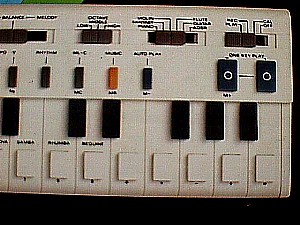
I own several Casio musical instruments. As is consistent with my aesthetic, they are are cheap and easy to buy. Casio was a company that sold calculators, and began selling musical instruments. The VL Tone was one of their earliest efforts.
I was in college at the time, and I didn't have a lot of money. This thing came out, and it had the rudimentary abilty to program sounds into it. I wrapped my mind around that. I dabbled in music and noisemaking (ala Eno etc) as I do now. I had to have one.
It took a month for me to get the money together, but I bought one, many years ago, and I still have it. I think it and a guitar would be enough I had to get rid of everything else.
What triggered me to write about it now is that I have been thinking a lot lately about what it takes to create things. There used to be technological barriers, but many of those are dropping. Video production, as an example, is very inexpensive in terms of equipment. But it still takes a lot of time to create something that people will watch and enjoy.
I just finished a rough cut on a video project, ran into lots of little snags with Final Cut, but in the end, got it done. My estimate on how long it would take me to do it was way off. But at the same time, I had to again marvel at what I could do -- editing a video project at the kitchen table.
The Casio VL Tone was/is brilliant in that it is an utterly approachable and affordable instrument that allowed just enough depth to allow some mastery. Beyond playing a song reasonably well, I could change the way it worked in ways that were interesting enough that I never really tired of it. It encouraged experimentation, within it's modest limitations.
Casio went on to make some other remarkable instruments, such as the SK-1 and SK-5 sampling keyboards. These are equally remarkable and creative as the lowly VL Tone. I have these as well. The VL Tone is special, though, because at the time it came out, the walkman was the device du jour. The VL Tone was sort of an extension of it, but in a way, the antithesis. Instead of listening to music, you could create it yourself. And you didn't have to be a musician to do it -- no one would judge with the headphones on.
Subscribe to:
Comments (Atom)