Sunday, October 08, 2006

MySpace is not Their Space

These collisions of personal rights, pubication and social computing are so damn interesting.

Latest news from NC State, University professor in hot water for using requiring his students to use myspace.

http://indyweek.gyrobase.com/gyrobase/Content?oid=38223

This is indeed a collision, a collision of things related to generational issues (but not what you think), institutional issues, expectations of privacy, and what does that really entail? There is of course the idea of content and authorship.

Content that students create may need to be private, or it may need to be public. The question is what happens to that content when the student leaves the university? I think the idea of creating a body of work is important for everyone. It can happen through many means. As we move to a purely electronic manifestation of our expressions, insights and knowledge, we may treat content differently. Because of the volume of information, we begin to treat it all as ephemeral. This is dangerous thinking, because much of it may not be. We really can' t decide.

Think of this. In the early 60's, television shows were recorded on early magnetic tape recorders, but some shows were still archived in film form as well. Because the tapes were expensive, the tapes were often reused, and television shows were then deleted forever. This may not seem like much, but it is important to note that this is a time where we have a medium that creates an artifact that is treated as ephemeral. Even junk printed matter is hoarded by people; complete collections of playboy, popular mechanics, old repair manuals, religous tracts. We come upon a time when the things we create are seen as transitory, vapor, perhaps because there is no physical artifact.

Myspace is a space where users create versions of themselves online, use it as a networking tool, a promotional tool. We are brought up different with ideas of how stature works, the 15 minutes of fame is a real and true thing in our world. It is possible to grab a brief flash of fame through manifestations like myspace because it is flat. It is reduced to peerage, networking and content.

Think of this in the context of a University. Universities offer courseware systems that have some features of Myspace, typically watered down, with much fewer options for student self-expression. Everything is focused on learning, but when we consider using courseware environments to teach in, they do not offer the richness of something like myspace, youtube or more combined. Because the encouragement is to string these services together, to build a multifaceted online manifestation, through tools like second life, wet paint, and so on.

When students wrote papers, the faculty member would grade them and give them back. It's the student's responsibility to archive. When we move to purely digital means of doing coursework, with no physical artifact as a result, the temptation is to treat this as ephemeral, like email. But it often isn't. This problem is usually addressed through some sort of "e-portfolio" system, but unless everyone addresses it, and the student still can use it when then leave the university, it's value is greatly reduced. For this to work, students need to have the ability to own their own work, even when they leave the university. As long as we stick with word document attachments and such, perhaps we will be fine, but what happens when we move to a environment that fully embraces that ridiculous term "Web 2.0", which means the content that the student creates is locked away?

I don't know what Universities will do. I think what I see in the reaction to a faculty member using Myspace to teach in is a glimpse of the future. It is not because of a generational difference, that the older people don't "get" myspace. Myspace's user community has grayed rapidly in the last year. I don't think that many faculty do actually have myspace accounts, because it works in a different way than other tools, such as email, static web pages, etc,, things we have just become to take for granted. In some ways it requires you to rethink ways you structure information, the way you approach work. This is not a good thing or a bad thing.

So what is the problem here? It's not accessibility, enough of myspace is accessible to be useful. Privacy? You choose yourself how much you want to make public and private. You don't have to answer all the questions. You do not need to post a picture of yourself.

Is it because it is something that is quite powerful, and perhaps seductive, in a way that Blackboard/WebCT Vista/D2L will never be? Because it lives in the world, and not in a campus.

I applaud Dr. Hoban for doing this. It pushes all the right buttons. This is something that Universities will have to address. Social computing, cyber existence outside of a university wall, how dow scholarly work inform this (there is so much that can be contributed here, such as formal peer review process to test for veracity). I hope that Universities just don't walk away, or perhaps as bad, try to do it themselves, but in a way where the walls exist, and work is locked away in the name of "privacy" or worse, "intellectual property". Myspace is not perfect, it's just another thing in a series of things, but the underlying ideas are powerful, and tap right into aspects of ourselves that rings true throughout time, that we want to leave our mark, we want to be seen and heard, we want to be remembered.

--hal

http://www.myspace.com/hal2k

Tuesday, September 26, 2006

An Open Letter to Independent Music Online


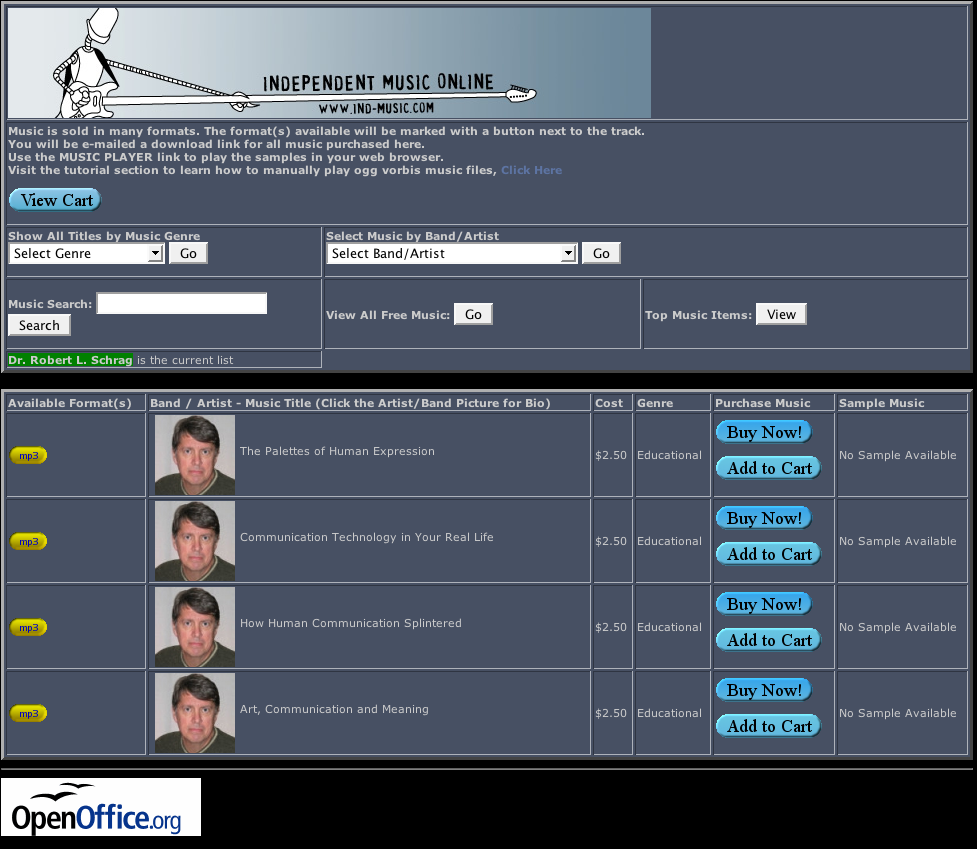
Patrick Hefner's Editorial on the recent fuss on Bob Schrag's university lectures being sold online via his companies Independent Music Online service illustrates several false assumptions about content ownership, intellectual property, and the whole mess we are in right now.

The editorial is surprisingly reactionary. It uses the tried and true "The Man Has Got to Be Paid" argument, ignoring the fact that in this case the "The Man" has been paid. Schrag's lectures have been paid for by the students that paid to take his course. His salary has been paid by the university. He is simply repackaging: taking content that he has already been paid to deliver, and creating derivative work that he then sells, splitting the profit between himself and a third party entity.

There is much lost in this thread. Mr. Hefner never acknowledges the tradition that is contrary to that of commercial music publication, which is the tradition of scholarly publication, peer review. Much of what we enjoy as accessibile knowledge, what is taught in our schools, the words that we use to describe our world, are essentially in the domain of public. It is almost arcane to think of these things as belonging to some sort of artificial hierarchy based on the economic model that knowledge is a restricted commodity, and thus should be priced accordingly.

His examples are, to put it mildly, lame. Throwing out judgement calls such as "evil money" is an attempt to blur the argument. I for one am not arguing whether we should all become communists, capitalists or something else. I am talking about pragmatism.

Here we are again -- but someone has to be paid! The author of a book, that tirelessly does research, takes painstaking notes, this person should of course derive benefit from their work.

I am not denying that. What I am saying that in this case, the author has already been paid.

IF Dr. Bob Schrag decides to produce a television series in his own spare time, hires production people, and pays their salaries, well -- he should be able to sell this work.

However, that is not the arrangement he is in now. He is abusing a system that allowed a great amount of latitude in how faculty use their intellectual pursuits to further their career. Many faculty write textbooks, of course derived from their experience in teaching the subject matter. The faculty are allowed to do this.

What is happening here is simply abuse of that privelege. Nothing more. It has nothing at all to do with justifying a business model. It has nothing to do with the University wanting to split the profits. In fact, this bit of insight on the part of Mr. Hefner shows how ensnared he is in one way of thinking of the world, how limited his view of the world is.

By the way, I just love the OpenOffice.Org ad at the bottom of the page listing Dr. Schrag's lectures. But wait -- how can that work! They are giving the software and source code away for free! That simply can't be right!

Friday, August 18, 2006

The Future, Unlocked

This is an abbreviated of a much longer story that I am writing. The best part is that it is not quite over yet.

This is a story of lust. This is a story of dreams. This is a story of good intentions and bad exectution. This is a story about a Nokia N70.

I had finished writing a paper for my class last spring, and was feeling elated. Hey.....I thought....let's go to to Ebay....

Anyone that knows me knows that I like small electronic gadgets. It is a perversity that I decry unusable design but I contingue to fall for little blinky things. I currently have a Sony Ericsson P900 (great phone) and a Blackberry 8700. But I really wanted....a Nokia N90, which is a curious hybrid of video camera and phone. And it costs $600 new.

But hey....what's this? The Nokia N70. Two cameras -- one in front for video conferencing, the other a 2 megapixel camera. Good reviews. And what do you know.....here's one for pretty cheap!

Let's bid! Oh, what the heck. I will lowball, and of course lose at the last minute.

What the heck! I won the bid. Cool. Oh wait....what's this? It's locked to Orange in the UK. Oh, that's not a problem. Nokia phones can be unlocked with software. No problemo.

Wow! What a cool phone. It's a little smaller than the P900. The screen is smaller, but that's okay. The camera is quite nice, way better than the P900. And it shoots video!

But wait.....what are all these people asking to get their N70 unlocked? What this thing about BB5?

(Fast Forward to Now)

So, I am looking at this phone these many months later, and it's still sits locked. A reminder of my folly, but also something that has taken me on a journey. I am planning on recounting this in full detail.

But for now, I want to fast forward to the conclusion. That devices that the end user won't be able to unlock are becoming the norm. The iPod bridges the gap between commonly supported commercial and non-commercial media sources, but your cable company's DVR is not yours to do with what you want. That would seem reasonable, since the cable company rents it to the customer.

But what about a cell phone? In the past, it was possible for customers to reuse cell phones, mainly GSM phones (the prevalent standard throughout the world). The Nokia N series (Nokia N70, N90, N93 etc) represent a device that the customer is never able to completely own, even if they buy it. They are at the mercy of the specific cell provider that issued the phone. In my case, it is Orange UK, which charges 20 pounds to unlock, but only if they decide that they want to. They don't have to do it.

So, these cell phones will end up in a landfill somewhere, because they can't be reused by moving to another carrier unless the carrier decides to release the phone, or someone shells out $$. This is really just presaging other devices tied to specific services, things build on "service models" that build in the essentially disposable nature of technology. This is the yard sale WebTV boxes, perhaps the future of Akimbo boxes.

This is not a sustainable future. I mean this from both an ecological viewpoint, but also from a society/culture/futurist viewpoint.

--hal

Thursday, August 03, 2006

Newton beats UMPC and maybe the $100 laptop

Whew, after the last post I think I need to something a little nicer.

CNet did a comparison between a Samsung UMPC (small form factor TabletPC) and a 10 year old Newton 2000, and the Newton won. This is interesting not just because it is good to still be able to poke fun at new Microsoft products (Vista jokes aren't even funny anymore, it is just too tragic). Face it, Microsoft has done a good job of marketing the TabletPC in education, but it still lacks a lot of basic, day to day functionality. Notice that convertible tables vastly outweigh tablets that don't have a keyboard. It is for the simple reason that the user experience really is not designed around the idea of a purely pen interface -- no legacy thinking tied to a keyboard or even a mouse. I wish I had more time to go into depth here on what that would mean (tie pressure to accelerated navigation, fast forwarding through data, menuing not tied to hierarchies based on linear lists). In a strange way, it is some of the same issues that come up in thinking of computer navigation for accessibility.

I think the important lesson that should be remembered in cnet's comparison is that is ultimately is not the hardware that matters. It really is the software. The newton wins because it is designed around a pen interface. A lot of things flow from that logically, including unique decisions on how data should be stored and represented. What happened to the Newton for myself is tragic, because the world could really use something like it now, using slightly faster hardware, better battery life, built in wireless. Kind of the like the Nokia 770, but more like.....a Newton.

And this is the thing that popped into my mind when I first heard of the MIT project to build a sub $200 PC for developing countries......the one computer per child initiative. While a commodity hardware platform is a nice idea, I prefer the idea of focusing on the software, and make it work on any kind of commodity computing platform that is being mass produced at the moment. Fast, cheap and out of control. For sure.

That would be a nice thing for Apple to do. Give it up, and let people have at it with the Newton. Make it run on the Nokia 770, or my cell phone. It could unlock devices that may be destined for the rubbish heap, and give them new life.

.....and then I woke up.

--hal

Blackboard patents LMS, Sues nearest competitor

Start here:

Blackboard LMS patent press release
Blackboard sues Desire2Learn

I believe that while the patent issue is a serious one, it is not what I think is most important. The patent issue is part of a generalized theme of bad decisions by the patent office on software/technology/internet/genetic engineering/etc. -- anything that doesn't end up in a manufactured, finished product (like a pen, bottle opener, paper clip, tank). Give me "Intellectual Property" for $200, Alex.

One potential bad outcome could be that Blackboard's patent is overturned. Whew! Boy, did we dodge that one! Let's get back to work on implementing WebCT Vista.....

The problem is tied to this patent, but it is not just the issue of whether these types of things are patentable, but that proprietary implementations of monolithic learning environments are actually anti-academic. They actually work against the things that are the core of a University's duties -- to teach, promote the expansion and transmission of knowledge. This is done through the free exchange of information. One key emphasis in environments such as Blackboard and WebCT is on *Containment* of information, restriction of access. I am reminded once again of the poor faculty who stated plainly that their course content was free for others to use, until it was pointed out to them that it *was not* free for anyone to use, because it is contained inside of WebCT.

I don't believe faculty have been made aware of the potential dangers here.

I don't mean to single any campus out. I think we are really at a crossroads in education now. What is and what is not important. Do we avail ourselves to the belief that what this university has to offer has to be contained, be treated as "intellectual property" in the lawsuit/licensing/DRM sense, or do we go with the academic tradition of authorship and publication/verification?

--hal

Friday, July 07, 2006

Tivo To Go For the Mac, $$$ version

I apologize in advance for posting this here, because it strains the usual threads in my blog, my whining about the state of education, media DRM/copyright, why palm is lame, etc.

This is a recipe for accomplishing something I have wanted to do for a long time, which is allow me to watch shows on my Tivo with my Mac without having to hack anything. Everything I talk about is off ther shelf, boring stuff. I just thought it would be good to document it because it is so easy to do.

First you need a PC running Windows XP. This part sucks, I agree, but that is because the Tivo Desktop for the PC has TivoToGo, which isn't available for the Mac. Whether or not it will become available is now irrelvant for me. I was lucky in that I scored a two year old Dell 400SC server (2 Ghz celeron) for $50.00 which I had to buy a drive for, and a XP license. If you are starting from scratch just buy the cheap nasty PC with a license for XP home included, nothing more than $300.00. But hopefully you will have this lying around.

You need to have a Tivo Series 2, connected to your home network. If you have put this part off, well duh! At least get a wired usb adapter, I am using a 3Com which I picked up for $14.00.

Download Tivo Desktop for your PC. DO NOT MAKE THE SAME MISTAKE I DID. Don't buy the Tivo Desktop Plus. I bought it and regret that decision. I wish I could give it back. It works (mostly) but has limitations (such as quality settings, etc). Use the free version.

If you have never set up Tivo Desktop before on your PC, you will need to go online and set up your Tivo to work with Tivo to go (log into your account). You will be furnished with a Media Access Key. If you have previously done this, you can get your key online when you log into your account.

Download and purchase Roxio's MyTVtoGo. It isn't quite a nicely integrated as Tivo's software, but it works great.

If you don't already have iTunes installed on your PC, download and install that.
Run iTunes and go through the legal blather stuff. After you have it running, go to Preferences, and Select Sharing. Check the box "Share my Library".

In any case, if you are successful, you will see your shows on your Tivo. You can of course select individual shows to download, but you can also instruct the software to download all shows for a given series, which is really handy, as you will see in a moment.

After you have downloaded a couple of shows, open MyTVToGo and configure it. For your video quality settings, use the iPod settings. I use the highest quality myself. Note that the software tells you that it will copy the converted files to our iTunes library.

MyTVToGo has a setting which allows the software to convert all new shows that show up in TivoToGo automatically. I highly recommend using this. Combined with the setting in TivoToGo that downloads the equivalent of a season pass from your Tivo allows the whole thing to essentially run itself. I leave mine alone, and when I go to iTunes on my Mac every day, new shows are added with no intervention on my part.

So, I have my PC setting behind my equipment in the living room, but it could just as well be in a closet somewhere. I run it remotely via Windows Desktop, but I actually prefer to use UltraVNC. Maintenance is basically dropping on the machine every once and while to download shows from the Tivo, or delete stuff I have already watched.

Otherwise, the thing pretty much runs itself. Any computer on the network that has iTunes installed can play stuff on the TivoToGo server.

It is of course possible to set up a shared volume on the PC so that I could just mount the drive and play back the shows, but I preferred using iTunes as my front end because it requires little or no configuration.

I should also point out that while it is simple for me to actually copy these shows to my iPod or burn them, in my case that is not my intent. I am not much of an archivist these days. After I have watched something I rarely want to keep a copy of it.

I know that I could have just hacked my Tivo, or built a MythTV box or blah blah blah. I have gone through many many many different attempts to replicate the Tivo experience, with the added ability to watch shows on my network, but Tivo still has the best overall user experience. I really hate that I had to go through this much trouble to do something that Tivo could supply to me via a TivoToGo for the Mac. Quite simply, I decided I had waited enough. I hope that someone finds useful.

I will write a separate article shortly outlining a parallel experience I am having with off-air digital television.

--hal