Not everyone knows that the startup sound for Windows 95 was created by none other than avant-garde musician/producer/artist Brian Eno, but what is just as much surprising to me is that his buddy Robert Fripp, certified guitar god (King Crimson, et al) is doing the sounds for the soon to be released (but perhaps not quite done) Windows Vista. Here's the video of Mr. Fripp doing some good old new age noodling.
I will spare myself and others the obvious snipes at Vista. It would be interesting if they were to hire *a lot* of different musicians, some perhaps unknown, and let them take a stab at creating sound sets for Vista, where the user could choose their own.
I know in the end it is just a dumb startup sound, and some soothing loops in the background while you fill out your registration for Vista (with checkboxes that read "yes, I would not like to have Microsoft not store all my personal information, and not share it with trusted partners"). We undoubtably will have to do this, or would we rather have our computer stop working after 30 days (okay, that is officially a joke.). I will leave this in the spirit of it being a good thing that a geniuely talented musician with a very long career got a sweet gig.
--hal
Tuesday, October 17, 2006


Monday, October 16, 2006
UserPlane + AOL sitting in a tree
UserPlane was bought by AOL a while back. There was much less coverage of it than the purchase of YouTube by Google, but I think it is almost as an important, certainly for the future of AOL.
UserPlane is a online chat tool, but combines the abilty to not just chat, but includes audio, video and file sharing. It is one step shy of tools such as Webex, or Microsoft's LiveMeeting, but it is free. If you can stand the advertising, and convince your friends to sign up, you can have a real live videoconference. The most important aspect of this is that the user does not have to have anything other than a browser and the most current version of the flash plugin. It uses the Flash Communication Server backend to do it's magic. People can create their own customized chat that appears right in their website.
I very much believe that this sort of service is the next big thing in online communication. We are still using tools that work best for non-synchronous communication (email, blogs, etc) but when we look at online gaming, it is the feeling that things are happening in realtime, that you are interacting with others, that makes these experiences compelling -- it is quite addictive. The reason it is not widespread has to do limitations of connectivity, complexity (it is too hard to set up) and simply because people are not necessarily comfortable with that. But when I watch the spread of Jabber use in our organization, it is clear that it offers advantages that a telephone can't -- namely the ability to push content (not just voice) to another user. This kind of experience is more natural than a simple text chat.
My guess is that AOL will roll this into their existing subscriber services at some point, making it a little more compelling reason to use their services. But then Google will come out with something similar, but Free ;-)
--hal
UserPlane is a online chat tool, but combines the abilty to not just chat, but includes audio, video and file sharing. It is one step shy of tools such as Webex, or Microsoft's LiveMeeting, but it is free. If you can stand the advertising, and convince your friends to sign up, you can have a real live videoconference. The most important aspect of this is that the user does not have to have anything other than a browser and the most current version of the flash plugin. It uses the Flash Communication Server backend to do it's magic. People can create their own customized chat that appears right in their website.
I very much believe that this sort of service is the next big thing in online communication. We are still using tools that work best for non-synchronous communication (email, blogs, etc) but when we look at online gaming, it is the feeling that things are happening in realtime, that you are interacting with others, that makes these experiences compelling -- it is quite addictive. The reason it is not widespread has to do limitations of connectivity, complexity (it is too hard to set up) and simply because people are not necessarily comfortable with that. But when I watch the spread of Jabber use in our organization, it is clear that it offers advantages that a telephone can't -- namely the ability to push content (not just voice) to another user. This kind of experience is more natural than a simple text chat.
My guess is that AOL will roll this into their existing subscriber services at some point, making it a little more compelling reason to use their services. But then Google will come out with something similar, but Free ;-)
--hal
Monday, October 09, 2006
Google and YouTube Marry and make many babies
http://www.google.com/press/pressrel/google_youtube.html
This is welcome news to me, as I like both services quite a bit. I think there is much afoot in this arena, but I am happier that Google bought them than a old media conglomerate, which would probably kill it (either on purpose or by accident).
What is next? I do hope the Apple/Google Video rumor is true. I really do want my Google/YouTube on my iTv.
--hal
This is welcome news to me, as I like both services quite a bit. I think there is much afoot in this arena, but I am happier that Google bought them than a old media conglomerate, which would probably kill it (either on purpose or by accident).
What is next? I do hope the Apple/Google Video rumor is true. I really do want my Google/YouTube on my iTv.
--hal
Sunday, October 08, 2006
MySpace is not Their Space
These collisions of personal rights, pubication and social computing are so damn interesting.
Latest news from NC State, University professor in hot water for using requiring his students to use myspace.
http://indyweek.gyrobase.com/gyrobase/Content?oid=38223
This is indeed a collision, a collision of things related to generational issues (but not what you think), institutional issues, expectations of privacy, and what does that really entail? There is of course the idea of content and authorship.
Content that students create may need to be private, or it may need to be public. The question is what happens to that content when the student leaves the university? I think the idea of creating a body of work is important for everyone. It can happen through many means. As we move to a purely electronic manifestation of our expressions, insights and knowledge, we may treat content differently. Because of the volume of information, we begin to treat it all as ephemeral. This is dangerous thinking, because much of it may not be. We really can' t decide.
Think of this. In the early 60's, television shows were recorded on early magnetic tape recorders, but some shows were still archived in film form as well. Because the tapes were expensive, the tapes were often reused, and television shows were then deleted forever. This may not seem like much, but it is important to note that this is a time where we have a medium that creates an artifact that is treated as ephemeral. Even junk printed matter is hoarded by people; complete collections of playboy, popular mechanics, old repair manuals, religous tracts. We come upon a time when the things we create are seen as transitory, vapor, perhaps because there is no physical artifact.
Myspace is a space where users create versions of themselves online, use it as a networking tool, a promotional tool. We are brought up different with ideas of how stature works, the 15 minutes of fame is a real and true thing in our world. It is possible to grab a brief flash of fame through manifestations like myspace because it is flat. It is reduced to peerage, networking and content.
Think of this in the context of a University. Universities offer courseware systems that have some features of Myspace, typically watered down, with much fewer options for student self-expression. Everything is focused on learning, but when we consider using courseware environments to teach in, they do not offer the richness of something like myspace, youtube or more combined. Because the encouragement is to string these services together, to build a multifaceted online manifestation, through tools like second life, wet paint, and so on.
When students wrote papers, the faculty member would grade them and give them back. It's the student's responsibility to archive. When we move to purely digital means of doing coursework, with no physical artifact as a result, the temptation is to treat this as ephemeral, like email. But it often isn't. This problem is usually addressed through some sort of "e-portfolio" system, but unless everyone addresses it, and the student still can use it when then leave the university, it's value is greatly reduced. For this to work, students need to have the ability to own their own work, even when they leave the university. As long as we stick with word document attachments and such, perhaps we will be fine, but what happens when we move to a environment that fully embraces that ridiculous term "Web 2.0", which means the content that the student creates is locked away?
I don't know what Universities will do. I think what I see in the reaction to a faculty member using Myspace to teach in is a glimpse of the future. It is not because of a generational difference, that the older people don't "get" myspace. Myspace's user community has grayed rapidly in the last year. I don't think that many faculty do actually have myspace accounts, because it works in a different way than other tools, such as email, static web pages, etc,, things we have just become to take for granted. In some ways it requires you to rethink ways you structure information, the way you approach work. This is not a good thing or a bad thing.
So what is the problem here? It's not accessibility, enough of myspace is accessible to be useful. Privacy? You choose yourself how much you want to make public and private. You don't have to answer all the questions. You do not need to post a picture of yourself.
Is it because it is something that is quite powerful, and perhaps seductive, in a way that Blackboard/WebCT Vista/D2L will never be? Because it lives in the world, and not in a campus.
I applaud Dr. Hoban for doing this. It pushes all the right buttons. This is something that Universities will have to address. Social computing, cyber existence outside of a university wall, how dow scholarly work inform this (there is so much that can be contributed here, such as formal peer review process to test for veracity). I hope that Universities just don't walk away, or perhaps as bad, try to do it themselves, but in a way where the walls exist, and work is locked away in the name of "privacy" or worse, "intellectual property". Myspace is not perfect, it's just another thing in a series of things, but the underlying ideas are powerful, and tap right into aspects of ourselves that rings true throughout time, that we want to leave our mark, we want to be seen and heard, we want to be remembered.
--hal
http://www.myspace.com/hal2k
Latest news from NC State, University professor in hot water for using requiring his students to use myspace.
http://indyweek.gyrobase.com/gyrobase/C
This is indeed a collision, a collision of things related to generational issues (but not what you think), institutional issues, expectations of privacy, and what does that really entail? There is of course the idea of content and authorship.
Content that students create may need to be private, or it may need to be public. The question is what happens to that content when the student leaves the university? I think the idea of creating a body of work is important for everyone. It can happen through many means. As we move to a purely electronic manifestation of our expressions, insights and knowledge, we may treat content differently. Because of the volume of information, we begin to treat it all as ephemeral. This is dangerous thinking, because much of it may not be. We really can' t decide.
Think of this. In the early 60's, television shows were recorded on early magnetic tape recorders, but some shows were still archived in film form as well. Because the tapes were expensive, the tapes were often reused, and television shows were then deleted forever. This may not seem like much, but it is important to note that this is a time where we have a medium that creates an artifact that is treated as ephemeral. Even junk printed matter is hoarded by people; complete collections of playboy, popular mechanics, old repair manuals, religous tracts. We come upon a time when the things we create are seen as transitory, vapor, perhaps because there is no physical artifact.
Myspace is a space where users create versions of themselves online, use it as a networking tool, a promotional tool. We are brought up different with ideas of how stature works, the 15 minutes of fame is a real and true thing in our world. It is possible to grab a brief flash of fame through manifestations like myspace because it is flat. It is reduced to peerage, networking and content.
Think of this in the context of a University. Universities offer courseware systems that have some features of Myspace, typically watered down, with much fewer options for student self-expression. Everything is focused on learning, but when we consider using courseware environments to teach in, they do not offer the richness of something like myspace, youtube or more combined. Because the encouragement is to string these services together, to build a multifaceted online manifestation, through tools like second life, wet paint, and so on.
When students wrote papers, the faculty member would grade them and give them back. It's the student's responsibility to archive. When we move to purely digital means of doing coursework, with no physical artifact as a result, the temptation is to treat this as ephemeral, like email. But it often isn't. This problem is usually addressed through some sort of "e-portfolio" system, but unless everyone addresses it, and the student still can use it when then leave the university, it's value is greatly reduced. For this to work, students need to have the ability to own their own work, even when they leave the university. As long as we stick with word document attachments and such, perhaps we will be fine, but what happens when we move to a environment that fully embraces that ridiculous term "Web 2.0", which means the content that the student creates is locked away?
I don't know what Universities will do. I think what I see in the reaction to a faculty member using Myspace to teach in is a glimpse of the future. It is not because of a generational difference, that the older people don't "get" myspace. Myspace's user community has grayed rapidly in the last year. I don't think that many faculty do actually have myspace accounts, because it works in a different way than other tools, such as email, static web pages, etc,, things we have just become to take for granted. In some ways it requires you to rethink ways you structure information, the way you approach work. This is not a good thing or a bad thing.
So what is the problem here? It's not accessibility, enough of myspace is accessible to be useful. Privacy? You choose yourself how much you want to make public and private. You don't have to answer all the questions. You do not need to post a picture of yourself.
Is it because it is something that is quite powerful, and perhaps seductive, in a way that Blackboard/WebCT Vista/D2L will never be? Because it lives in the world, and not in a campus.
I applaud Dr. Hoban for doing this. It pushes all the right buttons. This is something that Universities will have to address. Social computing, cyber existence outside of a university wall, how dow scholarly work inform this (there is so much that can be contributed here, such as formal peer review process to test for veracity). I hope that Universities just don't walk away, or perhaps as bad, try to do it themselves, but in a way where the walls exist, and work is locked away in the name of "privacy" or worse, "intellectual property". Myspace is not perfect, it's just another thing in a series of things, but the underlying ideas are powerful, and tap right into aspects of ourselves that rings true throughout time, that we want to leave our mark, we want to be seen and heard, we want to be remembered.
--hal
http://www.myspace.com/hal2k
Tuesday, September 26, 2006
An Open Letter to Independent Music Online
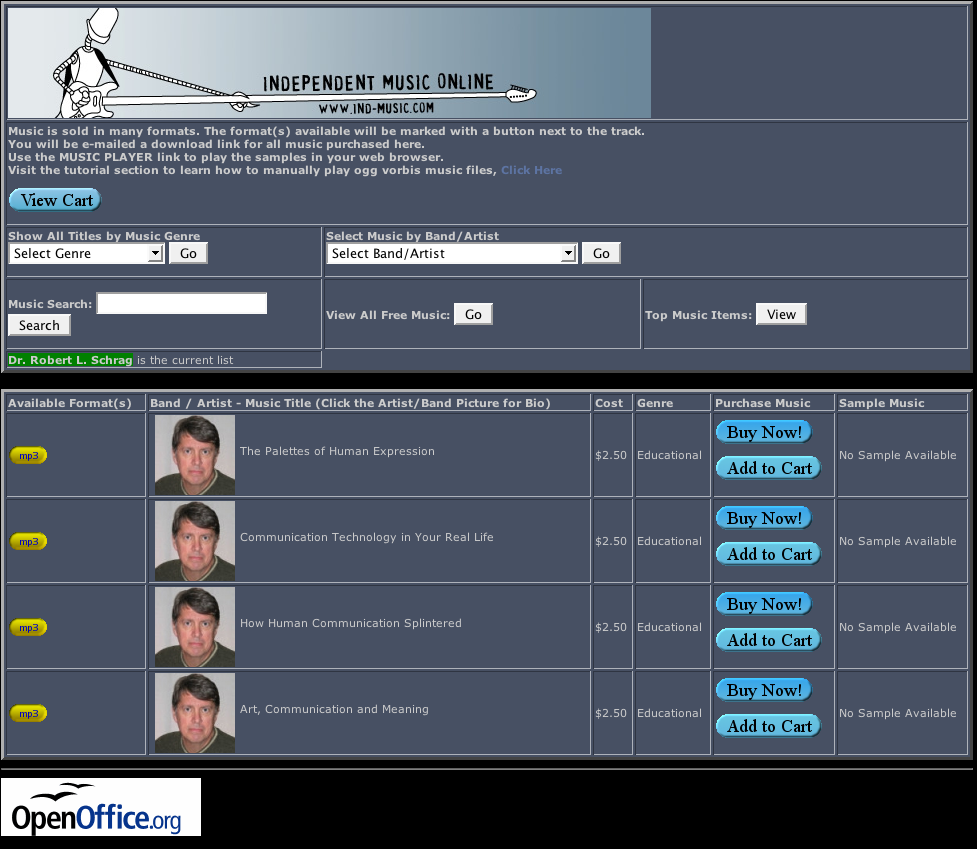
Patrick Hefner's Editorial on the recent fuss on Bob Schrag's university lectures being sold online via his companies Independent Music Online service illustrates several false assumptions about content ownership, intellectual property, and the whole mess we are in right now.
The editorial is surprisingly reactionary. It uses the tried and true "The Man Has Got to Be Paid" argument, ignoring the fact that in this case the "The Man" has been paid. Schrag's lectures have been paid for by the students that paid to take his course. His salary has been paid by the university. He is simply repackaging: taking content that he has already been paid to deliver, and creating derivative work that he then sells, splitting the profit between himself and a third party entity.
There is much lost in this thread. Mr. Hefner never acknowledges the tradition that is contrary to that of commercial music publication, which is the tradition of scholarly publication, peer review. Much of what we enjoy as accessibile knowledge, what is taught in our schools, the words that we use to describe our world, are essentially in the domain of public. It is almost arcane to think of these things as belonging to some sort of artificial hierarchy based on the economic model that knowledge is a restricted commodity, and thus should be priced accordingly.
His examples are, to put it mildly, lame. Throwing out judgement calls such as "evil money" is an attempt to blur the argument. I for one am not arguing whether we should all become communists, capitalists or something else. I am talking about pragmatism.
Here we are again -- but someone has to be paid! The author of a book, that tirelessly does research, takes painstaking notes, this person should of course derive benefit from their work.
I am not denying that. What I am saying that in this case, the author has already been paid.
IF Dr. Bob Schrag decides to produce a television series in his own spare time, hires production people, and pays their salaries, well -- he should be able to sell this work.
However, that is not the arrangement he is in now. He is abusing a system that allowed a great amount of latitude in how faculty use their intellectual pursuits to further their career. Many faculty write textbooks, of course derived from their experience in teaching the subject matter. The faculty are allowed to do this.
What is happening here is simply abuse of that privelege. Nothing more. It has nothing at all to do with justifying a business model. It has nothing to do with the University wanting to split the profits. In fact, this bit of insight on the part of Mr. Hefner shows how ensnared he is in one way of thinking of the world, how limited his view of the world is.
By the way, I just love the OpenOffice.Org ad at the bottom of the page listing Dr. Schrag's lectures. But wait -- how can that work! They are giving the software and source code away for free! That simply can't be right!
Wednesday, September 13, 2006
Friday, August 18, 2006
The Future, Unlocked
This is an abbreviated of a much longer story that I am writing. The best part is that it is not quite over yet.
This is a story of lust. This is a story of dreams. This is a story of good intentions and bad exectution. This is a story about a Nokia N70.
I had finished writing a paper for my class last spring, and was feeling elated. Hey.....I thought....let's go to to Ebay....
Anyone that knows me knows that I like small electronic gadgets. It is a perversity that I decry unusable design but I contingue to fall for little blinky things. I currently have a Sony Ericsson P900 (great phone) and a Blackberry 8700. But I really wanted....a Nokia N90, which is a curious hybrid of video camera and phone. And it costs $600 new.
But hey....what's this? The Nokia N70. Two cameras -- one in front for video conferencing, the other a 2 megapixel camera. Good reviews. And what do you know.....here's one for pretty cheap!
Let's bid! Oh, what the heck. I will lowball, and of course lose at the last minute.
What the heck! I won the bid. Cool. Oh wait....what's this? It's locked to Orange in the UK. Oh, that's not a problem. Nokia phones can be unlocked with software. No problemo.
Wow! What a cool phone. It's a little smaller than the P900. The screen is smaller, but that's okay. The camera is quite nice, way better than the P900. And it shoots video!
But wait.....what are all these people asking to get their N70 unlocked? What this thing about BB5?
(Fast Forward to Now)
So, I am looking at this phone these many months later, and it's still sits locked. A reminder of my folly, but also something that has taken me on a journey. I am planning on recounting this in full detail.
But for now, I want to fast forward to the conclusion. That devices that the end user won't be able to unlock are becoming the norm. The iPod bridges the gap between commonly supported commercial and non-commercial media sources, but your cable company's DVR is not yours to do with what you want. That would seem reasonable, since the cable company rents it to the customer.
But what about a cell phone? In the past, it was possible for customers to reuse cell phones, mainly GSM phones (the prevalent standard throughout the world). The Nokia N series (Nokia N70, N90, N93 etc) represent a device that the customer is never able to completely own, even if they buy it. They are at the mercy of the specific cell provider that issued the phone. In my case, it is Orange UK, which charges 20 pounds to unlock, but only if they decide that they want to. They don't have to do it.
So, these cell phones will end up in a landfill somewhere, because they can't be reused by moving to another carrier unless the carrier decides to release the phone, or someone shells out $$. This is really just presaging other devices tied to specific services, things build on "service models" that build in the essentially disposable nature of technology. This is the yard sale WebTV boxes, perhaps the future of Akimbo boxes.
This is not a sustainable future. I mean this from both an ecological viewpoint, but also from a society/culture/futurist viewpoint.
--hal
This is a story of lust. This is a story of dreams. This is a story of good intentions and bad exectution. This is a story about a Nokia N70.
I had finished writing a paper for my class last spring, and was feeling elated. Hey.....I thought....let's go to to Ebay....
Anyone that knows me knows that I like small electronic gadgets. It is a perversity that I decry unusable design but I contingue to fall for little blinky things. I currently have a Sony Ericsson P900 (great phone) and a Blackberry 8700. But I really wanted....a Nokia N90, which is a curious hybrid of video camera and phone. And it costs $600 new.
But hey....what's this? The Nokia N70. Two cameras -- one in front for video conferencing, the other a 2 megapixel camera. Good reviews. And what do you know.....here's one for pretty cheap!
Let's bid! Oh, what the heck. I will lowball, and of course lose at the last minute.
What the heck! I won the bid. Cool. Oh wait....what's this? It's locked to Orange in the UK. Oh, that's not a problem. Nokia phones can be unlocked with software. No problemo.
Wow! What a cool phone. It's a little smaller than the P900. The screen is smaller, but that's okay. The camera is quite nice, way better than the P900. And it shoots video!
But wait.....what are all these people asking to get their N70 unlocked? What this thing about BB5?
(Fast Forward to Now)
So, I am looking at this phone these many months later, and it's still sits locked. A reminder of my folly, but also something that has taken me on a journey. I am planning on recounting this in full detail.
But for now, I want to fast forward to the conclusion. That devices that the end user won't be able to unlock are becoming the norm. The iPod bridges the gap between commonly supported commercial and non-commercial media sources, but your cable company's DVR is not yours to do with what you want. That would seem reasonable, since the cable company rents it to the customer.
But what about a cell phone? In the past, it was possible for customers to reuse cell phones, mainly GSM phones (the prevalent standard throughout the world). The Nokia N series (Nokia N70, N90, N93 etc) represent a device that the customer is never able to completely own, even if they buy it. They are at the mercy of the specific cell provider that issued the phone. In my case, it is Orange UK, which charges 20 pounds to unlock, but only if they decide that they want to. They don't have to do it.
So, these cell phones will end up in a landfill somewhere, because they can't be reused by moving to another carrier unless the carrier decides to release the phone, or someone shells out $$. This is really just presaging other devices tied to specific services, things build on "service models" that build in the essentially disposable nature of technology. This is the yard sale WebTV boxes, perhaps the future of Akimbo boxes.
This is not a sustainable future. I mean this from both an ecological viewpoint, but also from a society/culture/futurist viewpoint.
--hal
Subscribe to:
Posts (Atom)